
Book a Demo
Conditions
How EASE Compares to Global tDCS Devices
tDCS is not new. It has been adopted by leading companies, regulators, and health systems across the world. What is new — and what EASE represents — is the next generation of closed-loop, precision stimulation systems that combine stimulation with real-time brain monitoring and therapeutic training.
Here is how EASE compares to the three most significant global players in the tDCS space.

The Global tDCS Landscape — Who's Who
Flow Neuroscience (Sweden/UK)
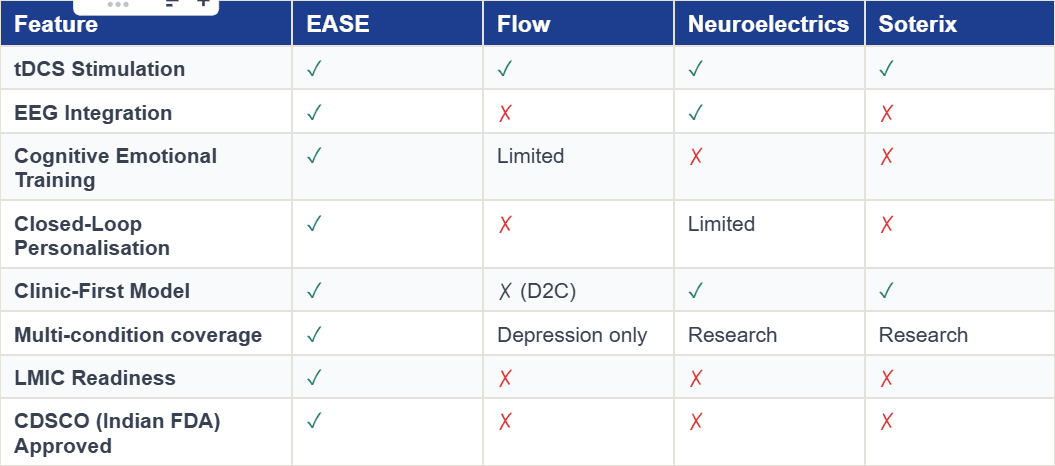
Flow Neuroscience is the global D2C leader in tDCS. Their device received FDA approval in late 2025 for at-home depression treatment — the first such approval in the US. Flow is CE-certified, integrated into multiple NHS trusts in the UK, and has treated 55,000+ patients globally. Their strength is clinical credibility for depression and an excellent app-guided therapy programme. Their limitation: they treat depression only, have no EEG integration, offer limited CET, and are a consumer product rather than a clinician-supervised clinical tool.
Neuroelectrics (Spain/USA)
Neuroelectrics makes the Starstim device — a research-grade EEG-tDCS combination platform used in academic and clinical research settings. It is CE-certified and has received FDA Breakthrough Device Designation. Their strength is the combination of EEG and tDCS in a single device. Their limitation: they have no mental health-specific CET layer, are priced and positioned for institutional research rather than scalable clinical practice, and are not designed for LMICs (low- and middle-income countries).
Soterix Medical (USA)
Soterix Medical produces clinical-grade tDCS kits used in FDA trials and research settings. They are not a commercial treatment device — they supply the equipment used by researchers to conduct tDCS studies. Their strength is the precision and configurability of their research-grade equipment. Their limitations: no EEG, no CET, no commercial patient-facing offering, and not designed for clinical practice outside of research protocols.
Feature Comparison: EASE vs Flow vs Neuroelectrics vs Soterix
What EASE Does That No Other Device Does Globally
EASE is the only tDCS device globally that combines all of the following in a single integrated system:
tDCS brain stimulation (and tACS and tRNS for specific conditions)
Real-time EEG brain monitoring for objective biomarker tracking
Mental health-specific Cognitive Emotional Training delivered during stimulation
Closed-loop personalisation — EEG data informs stimulation protocol
Clinic-first model with remote doctor oversight
CDSCO Class B approval — India's only licensed device in this category
LMIC readiness — designed to be affordable and scalable in India and similar markets
This is not a marginal improvement on existing devices. It is a fundamentally different approach: one that treats the brain as a system to be monitored and trained, not just stimulated.
Why Clinic-First Beats Direct-to-Consumer for Outcomes
Flow Neuroscience's success in the UK and US demonstrates that tDCS works for depression in a D2C context. But the EASE thesis — backed by the evidence from its AIIMS study — is that outcomes are significantly better when treatment is clinician-supervised, EEG-guided, and combined with structured cognitive training. The patient who uses a D2C headset at home without medical oversight, EEG monitoring, or a structured CET programme is receiving a fraction of what the technology is capable of.
Why EASE Was Built for India, UK, and the US — Not Sweden
Flow Neuroscience was designed for the Scandinavian and UK healthcare market: well-resourced, NHS-integrated, highly literate in prescription devices. Neuroelectrics was designed for institutional research. EASE was designed for the Indian healthcare context: a clinic-first model that works within the existing psychiatric practice structure, an affordable device (35% cheaper than comparable foreign alternatives), CDSCO regulatory compliance, and a business model (one-time sale and revenue sharing) that works for both tier-1 and tier-2/3 city practitioners.
And with NHS MOUs already in progress and a 510K pathway to the US planned, EASE is building global validation from an Indian-first foundation — not retrofitting a foreign device for an Indian context.