
Book a Demo
EASE - India's First
Closed-Loop Brain Stimulation Device
The brain is an electrochemical organ. When its electrical networks fall out of balance due to depression, anxiety, addiction, or cognitive decline restoring that balance requires a targeted, intelligent intervention. EASE is that intervention.
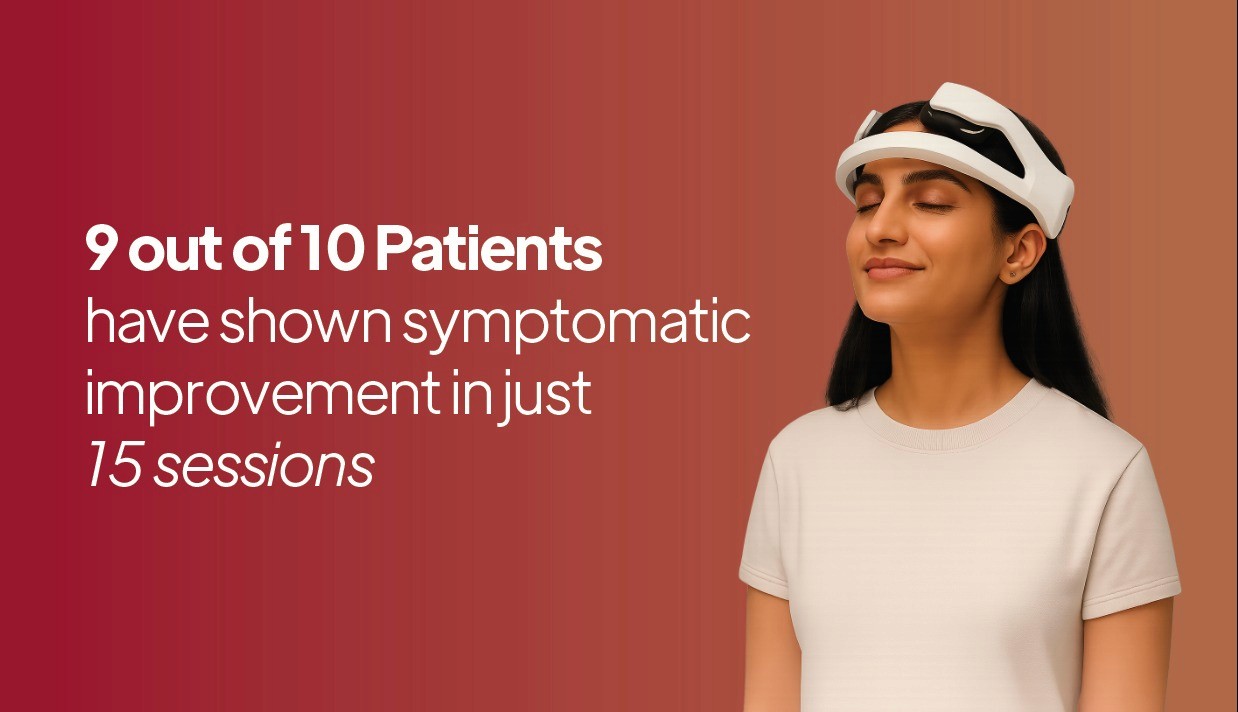
EASE is India's first and only CDSCO-approved neuromodulation device that combines three technologies into a single, wearable system: brain stimulation (tES), brain monitoring (EEG), and cognitive training (CET). Together, these three layers create a closed-loop treatment platform that no other device in India or globally in this combination can match.
What Does EASE Stand For?
EASE stands for Executive Functioning and Affective Salience through Stimulation and EEG. Every word in that name reflects a specific therapeutic goal: improving executive function (attention, decision-making, impulse control), addressing emotional and mood dysregulation (affective salience), through a combination of electrical stimulation and real-time brain monitoring.
The Three-Layer System: tDCS · EEG · CET
Layer 1
tDCS - stimulating the brain to restore balance
The upper band of the EASE headset delivers Transcranial Electrical Stimulation (tES) - a group of techniques that send gentle, low-intensity electrical currents to the scalp. Different conditions call for different stimulation modes. For depression and OCD, tDCS (Transcranial Direct Current Stimulation) is used to increase activity in the left DLPFC. For insomnia and anxiety, tACS (Transcranial Alternating Current Stimulation) can entrain neural oscillations to promote relaxation and sleep. For addiction and executive dysfunction, tRNS (Transcranial Random Noise Stimulation) shows particular promise. EASE's platform supports all of these modes, giving doctors the flexibility to personalise treatment to each patient.
Layer 2
EEG - listening to the brain in real time
The lower band of the EASE headset contains EEG sensors that continuously monitor your brain's electrical activity during every session. This is what makes EASE uniquely intelligent: it is not simply delivering stimulation, it is reading the brain's response and generating objective data that your doctor can use to refine and personalise your treatment. EEG patterns can identify biomarkers, such as frontal alpha asymmetry in depression, or elevated beta in anxiety that guide treatment decisions with a level of precision that questionnaires alone cannot provide.
Layer 3
CET - training the brain while the window is open
Cognitive Emotional Training is the guided exercise programme delivered through the EASE app during each session. When the brain is being stimulated, it enters a state of heightened neuroplasticity, a window during which new neural connections form more readily. CET exercises designed to target attention, working memory, emotional regulation, and impulse control — are delivered during this window. Think of it as the difference between doing physiotherapy before surgery versus after: timing the training to the stimulation dramatically amplifies the results.
Why Combining All Three Produces Better Outcomes Than Any One Alone
Each layer of EASE addresses a different aspect of the treatment challenge:
tES alone changes the brain's excitability but without targeted training, the brain may not form the right new connections
CET alone improves cognitive skills but without priming the brain's neuroplasticity, the gains are slower and less persistent
EEG alone provides data but without the ability to act on that data through personalised stimulation, it is diagnosis without treatment
Combined, the three layers create a feedback loop: EEG data informs the stimulation protocol, stimulation opens the neuroplastic window, and CET directs what grows in that window. This is what "closed-loop" means the system adapts to the individual brain rather than delivering a one-size-fits-all intervention.
CDSCO Class B Approved
India's Only Licensed Device in This Category
EASE is the first and only medical device in India to receive CDSCO (Central Drugs Standard Control Organisation) Class B approval for neuromodulation in the neuropsychiatric category. This is India's FDA equivalent and it means EASE has passed rigorous testing for safety, efficacy, and manufacturing standards. EASE also meets 8+ ISO/IEC international standards.
This approval matters for patients and doctors alike. It is the difference between a consumer wellness gadget and a medically certified treatment.
How ease delivers results?
EASE is a portable, wearable headband designed for ease of use. The upper part of the band delivers stimulation; the lower part reads brain activity via EEG sensors. The device connects to the EASE app via Bluetooth. The app manages your session, delivers your CET programme, tracks your mood and symptom scores, and gives your doctor remote access to your EEG data and treatment progress.
Sessions last 20 to 30 minutes and can be completed at a partner clinic or at home after your doctor has configured your personalised protocol.
Validated at AIIMS Delhi
the Science Behind the Results
AIIMS Delhi Clinical Validation Study: 63.8% average reduction in HAM-D and MADRS depression scores. 84% of patients achieved remission. 20 sessions of tDCS (anode left DLPFC) + CET.
The EASE protocol was validated at the Department of Psychiatry, All India Institute of Medical Sciences (AIIMS), New Delhi. The study showed 63.8% average reduction in depression severity scores and 84% remission after 20 sessions, making it one of the strongest validation results for any combined neuromodulation protocol in India.
The technology that powers EASE is backed by over 200 peer-reviewed studies on tDCS globally, and by international validation at AIIMS Delhi, NIMHANS, CIP Ranchi, KMC Manipal, and MGH Boston.
Find a Doctor Near You
EASE is available through a network of 40+ partner hospitals and psychiatrists across India. To find a doctor in your city who offers EASE treatment, visit our doctor directory.
Or fill in our patient form and we will connect you with the right specialist