
Book a Demo
How EASE Compares
to Global tDCS Devices
tDCS is not new. It has been adopted by leading companies, regulators, and health systems across the world. What is new and what EASE represents is the next generation of closed-loop, precision stimulation systems that combine stimulation with real-time brain monitoring and therapeutic training.
Here is how EASE compares to the three most significant global players in the tDCS space.
The Global tDCS Landscape - Who's Who
Flow Neuroscience (Sweden/UK)
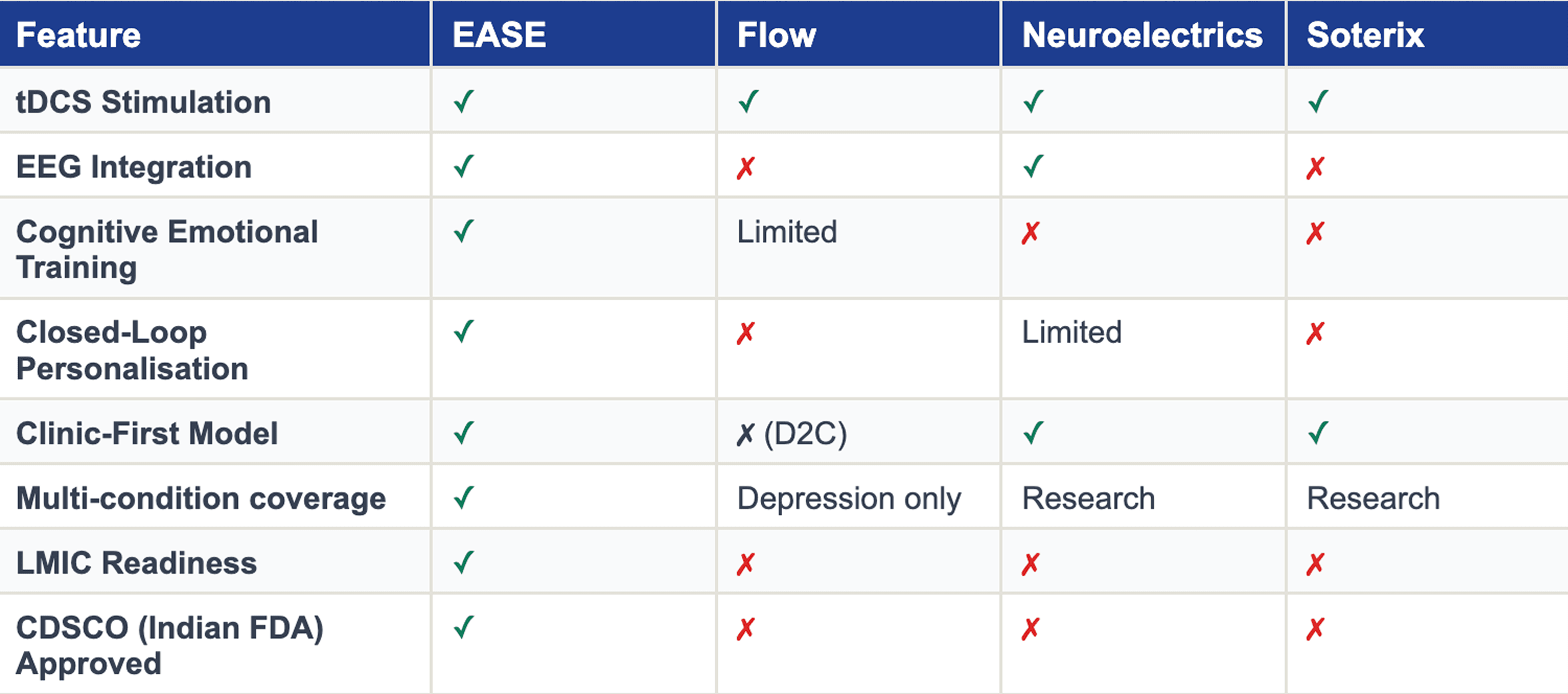
Flow Neuroscience is the global D2C leader in tDCS. Their device received FDA approval in late 2025 for at-home depression treatment, the first such approval in the US. Flow is CE-certified, integrated into multiple NHS trusts in the UK, and has treated 55,000+ patients globally. Their strength is clinical credibility for depression and an excellent app-guided therapy programme. Their limitation: they treat depression only, have no EEG integration, offer limited CET, and are a consumer product rather than a clinician-supervised clinical tool.
Neuroelectrics (Spain/USA)
Neuroelectrics makes the Starstim device, a research-grade EEG-tDCS combination platform used in academic and clinical research settings. It is CE-certified and has received FDA Breakthrough Device Designation. Their strength is the combination of EEG and tDCS in a single device. Their limitation: they have no mental health-specific CET layer, are priced and positioned for institutional research rather than scalable clinical practice, and are not designed for LMICs (low- and middle-income countries).
Soterix Medical (USA)
Soterix Medical produces clinical-grade tDCS kits used in FDA trials and research settings. They are not a commercial treatment device, they supply the equipment used by researchers to conduct tDCS studies. Their strength is the precision and configurability of their research-grade equipment. Their limitations: no EEG, no CET, no commercial patient-facing offering, and not designed for clinical practice outside of research protocols.
Feature Comparison: EASE vs Flow vs Neuroelectrics vs Soterix
What EASE Does That No Other Device Does Globally
EASE is the only tDCS device globally that combines all of the following in a single integrated system:
tDCS brain stimulation (and tACS and tRNS for specific conditions)
Real-time EEG brain monitoring for objective biomarker tracking
Mental health-specific Cognitive Emotional Training delivered during stimulation
Closed-loop personalisation EEG data informs stimulation protocol
Clinic-first model with remote doctor oversight
CDSCO Class B approval India's only licensed device in this category
LMIC readiness designed to be affordable and scalable in India and similar markets
This is not a marginal improvement on existing devices. It is a fundamentally different approach: one that treats the brain as a system to be monitored and trained, not just stimulated.
Why Clinic-First Beats Direct-to-Consumer for Outcomes
Flow Neuroscience's success in the UK and US demonstrates that tDCS works for depression in a D2C context. But the EASE thesis backed by the evidence from its AIIMS study is that outcomes are significantly better when treatment is clinician-supervised, EEG-guided, and combined with structured cognitive training. The patient who uses a D2C headset at home without medical oversight, EEG monitoring, or a structured CET programme is receiving a fraction of what the technology is capable of.
Why EASE Was Built for India, UK, and the US - Not Sweden
Flow Neuroscience was designed for the Scandinavian and UK healthcare market: well-resourced, NHS-integrated, highly literate in prescription devices. Neuroelectrics was designed for institutional research. EASE was designed for the Indian healthcare context: a clinic-first model that works within the existing psychiatric practice structure, an affordable device (35% cheaper than comparable foreign alternatives), CDSCO regulatory compliance, and a business model (one-time sale and revenue sharing) that works for both tier-1 and tier-2/3 city practitioners.
And with NHS MOUs already in progress and a 510K pathway to the US planned, EASE is building global validation from an Indian-first foundation, not retrofitting a foreign device for an Indian context.
Find a Doctor Near You
EASE is available through a network of 40+ partner hospitals and psychiatrists across India. To find a doctor in your city who offers EASE treatment, visit our doctor directory.
Or fill in our patient form and we will connect you with the right specialist