
Book a Demo
Depression Treatment in India Without Medication
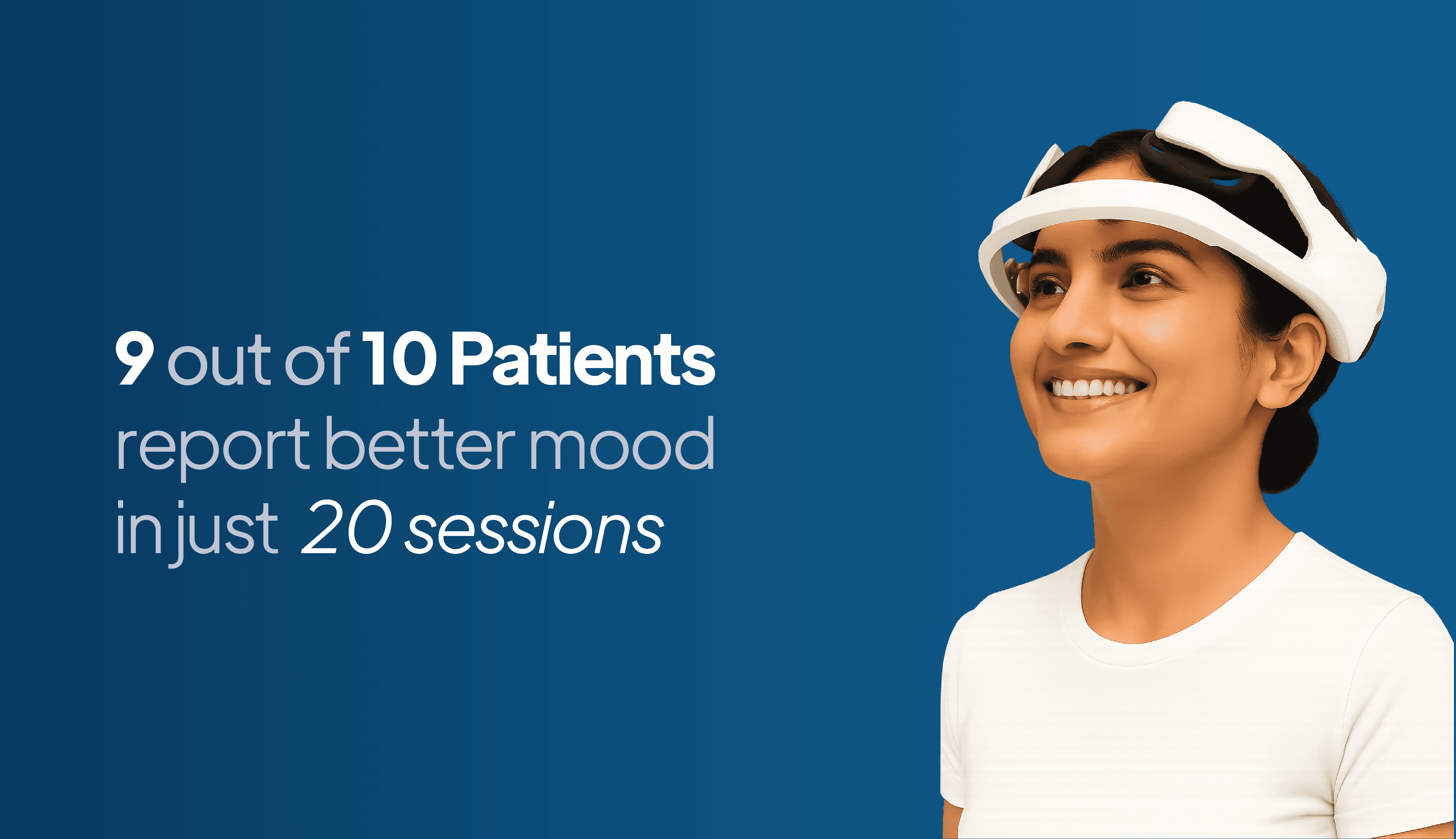
Depression is one of the most common - and most misunderstood - mental health conditions in India. Millions of people try antidepressants, experience side effects they can't tolerate, and are left wondering if there's another way. There is. EASE is India's first and only CDSCO-approved brain stimulation device for depression. In a clinical validation study at AIIMS Delhi, patients using EASE saw a 63.8% average reduction in depression symptoms, and 84% achieved remission without medication. Whether you want to avoid medication entirely, or complement your existing treatment, EASE offers a clinically validated, non-invasive, drug-free path forward.
What's Happening in the Brain During Depression
Depression is not a character flaw or a bad attitude. It is a measurable change in how your brain functions. When you understand what's actually happening neurologically, the logic behind EASE becomes clear.
The DLPFC goes quiet and thinking clearly becomes hard
The dorsolateral prefrontal cortex, or DLPFC, is the part of your brain responsible for focus, decision-making, emotional regulation, and breaking out of negative thought loops. In depression, this area becomes significantly underactive. When your DLPFC is not firing properly, it becomes hard to concentrate, hard to feel motivated, and almost impossible to pull yourself out of a spiral of self-critical thinking.
The Hidden Time Drain in Every Team
Alongside the DLPFC going quiet, another brain network called the Default Mode Network, becomes overactive. This network governs self-referential thinking: your inner monologue about yourself, your past, your fears, and your future. When it's overactive, you get trapped in loops of rumination, worry, and self-criticism. This is not weakness. This is a measurable brain state that can be changed.
The limbic system becomes hypersensitive
The limbic system which includes the amygdala processes emotional reactions to the world around you. In depression, this system becomes overly sensitive. Small problems feel catastrophic. Normal frustrations feel overwhelming. This emotional amplification is not disproportionate to your situation, it's a direct result of how the depressed brain is wired.
How EASE Treats Depression tDCS + EEG + CET Explained
EASE uses three technologies working together as a single closed-loop system. Each layer targets a different aspect of depression.
tDCS - reactivating the quiet parts of your brain
Transcranial Direct Current Stimulation (tDCS) is the core of the EASE device. A low-amplitude electrical current just 1 to 2 milliamperes, which is 400 times less than ECT is delivered to the left DLPFC through the upper band of the headset. This gently increases the excitability of neurons in that region, encouraging them to fire and reconnect. Over 200 peer-reviewed studies support tDCS as an effective non-pharmacological treatment for depression. A 10-week randomised controlled trial published in the New England Journal of Medicine found tDCS to be significantly more effective than placebo.
EEG - reading your brain in real time
The lower band of EASE contains EEG sensors that monitor your brain's electrical activity during every session. This does something no other tDCS device in India can do: it gives your doctor objective data about how your brain is responding to treatment. Rather than relying entirely on how you feel on a given day which is subjective and variable your doctor can see your brain's biomarkers and adjust your treatment accordingly. Frontal alpha asymmetry patterns, which predict antidepressant response, can be tracked and measured.
CET - training the brain while the window is open
Cognitive Emotional Training (CET) is the guided digital exercise programme delivered through the EASE app during each session. When tDCS stimulates the brain, it opens a window of heightened neuroplasticity the brain's ability to form new connections. CET exercises, which include attention tasks, emotional recognition exercises, and working memory challenges, take advantage of this window. Think of it the way physiotherapy works alongside surgery: the stimulation creates the conditions for change, and the CET exercises direct what that change becomes.
What the AIIMS Delhi Study Found
Source: Clinical Validation of EASE Protocol for Depression Treatment, Department of Psychiatry, AIIMS Delhi. Intervention: 20 sessions of tDCS (anode left DLPFC) combined with CET, morning and evening. Primary Measures: HAM-D, MADRS, EEG assessments.
The validation study for EASE was conducted at the Department of Psychiatry, All India Institute of Medical Sciences (AIIMS), New Delhi one of the most respected medical institutions in India.
63.8% average reduction in HAM-D and MADRS depression severity scores
84% of patients achieved remission after 20 sessions
Significant improvements in attention, motivation, and sleep quality
Treatment was administered as 20 sessions combining tDCS stimulation with CET exercises
These results are not from general tDCS literature. They are from a study of the specific EASE protocol the same combination of device and training that your doctor uses when you start treatment.
Find a Doctor Near You
EASE is available through a network of 40+ partner hospitals and psychiatrists across India. To find a doctor in your city who offers EASE treatment, visit our doctor directory.
Or fill in our patient form and we will connect you with the right specialist
Frequently Asked Questions
Is EASE Right for You?
What a Treatment Session Looks Like
Is EASE effective for severe depression?
Can I use EASE alongside my antidepressants?
How many sessions does it take to see results?
Is tDCS safe? What are the side effects?
How do I find a doctor who offers EASE in India?